
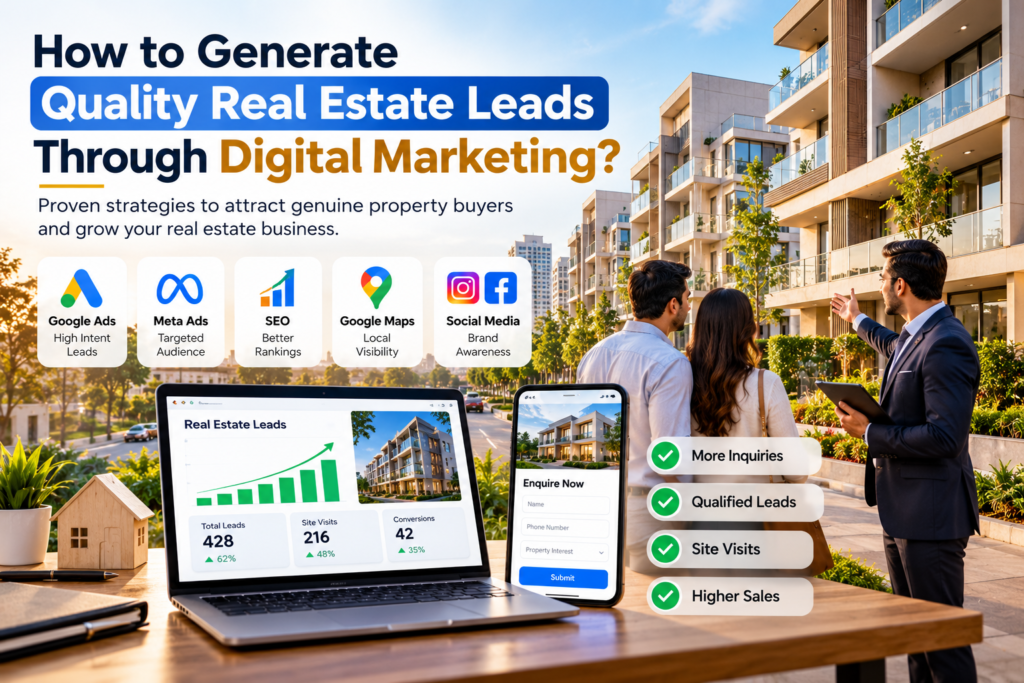
If you are a real estate builder, property dealer, or consultant, you already know that finding cShopustomers is not always easy. You may have attractive properties, competitive prices, and a good location, but still struggle to get genuine inquiries.
Sometimes you receive calls from people who are only exploring the market. Others may have a budget that does not match your property, or they may stop responding after the first conversation.
This is where digital marketing can make a real difference.
With the right strategy, you can reach people who are interested in buying a flat, investing in property, purchasing a plot, or finding their dream home. More importantly, you can build a system that helps you attract relevant inquiries and follow up with potential buyers.
In this blog, we will explore how to generate quality real estate leads through digital marketing and how your business can use online platforms more effectively.
What Is a Quality Real Estate Lead?
A lead is someone who shows interest in your property or real estate services. However, not every inquiry is a potential customer.
For example, someone may fill out a form to enquire about a luxury apartment but have a budget suitable only for a smaller property. Another person may be actively looking for a 3BHK apartment in Mohali and have the budget and timeline to make a purchase.
The second person may be a more relevant lead for that particular project.
A quality real estate lead generally has a genuine interest in your offering, a suitable budget, a relevant location preference, and a realistic buying timeline.
Your marketing strategy should focus not just on increasing the number of inquiries, but also on attracting people who are more likely to become customers.
1. Run Facebook and Instagram Ads for Real Estate
Facebook and Instagram are useful platforms for showcasing properties because people can discover your projects through photos, videos, reels, and advertisements.
You can promote residential apartments, luxury villas, commercial spaces, plots, and new housing projects to relevant audiences.
For example, if you are promoting a residential project in Mohali, your advertisements could highlight:
- Property location and nearby facilities
- Apartment configurations such as 2BHK and 3BHK
- Starting price or price range, where appropriate
- Amenities, layouts, and project photographs
- Site visit opportunities and inquiry details
Use genuine project photos and videos wherever possible. A short walkthrough video or a clear explanation of the property’s key benefits can help potential buyers understand what you are offering.
You can direct interested users to a website landing page, an instant lead form, or WhatsApp, depending on your sales process.
Pro tip: Do not use the same advertisement for every property. A campaign for affordable housing should communicate different benefits from a campaign promoting luxury apartments.
For housing-related advertising, check the applicable Meta advertising policies and targeting restrictions before launching your campaign.
2. Use Google Ads to Reach People Actively Searching for Property
Social media can help people discover a property they were not previously considering. Google Ads can help you reach people who are already searching for specific real estate options.
For example, potential buyers may search for:
- Flats for sale in Mohali
- 3BHK apartments in Chandigarh
- Residential plots in Zirakpur
- Commercial property in Panchkula
- New residential projects near Chandigarh
Google Search campaigns can connect your business with relevant searches when your keywords, location settings, advertisements, and landing pages match the user’s needs.
Instead of sending every visitor to your homepage, create dedicated landing pages for individual projects or property categories.
A good landing page should include clear property details, genuine images, location information, important amenities, a visible contact option, and a simple inquiry form.
Google Ads costs vary depending on competition, keywords, location, and campaign quality. Track the quality of inquiries before deciding whether to increase your advertising budget.
3. Build a Website That Converts Visitors into Leads
Your website is often one of the first places where potential buyers learn more about your business.
If someone clicks your advertisement but cannot find the property price range, location, floor plans, or contact details, they may leave without enquiring.
A real estate website should make it easy for visitors to understand your offering and take the next step.
Consider including:
- Separate pages for each property or project
- High-quality photos and property walkthrough videos
- Floor plans and relevant project details
- Location maps and nearby landmarks
- Mobile-friendly inquiry forms
- Click-to-call and WhatsApp options
- Clear calls to action, such as “Request Property Details” or “Schedule a Site Visit”
Keep inquiry forms simple. You can ask for a name, phone number, preferred property type, and approximate budget where appropriate. Additional questions can be asked during the first conversation.
Make sure you collect and use personal information responsibly and provide appropriate privacy information.
4. Improve Your Google Business Profile with Local SEO
When people search for real estate services in their area, local search results can help them discover relevant businesses.
A properly maintained Google Business Profile can support your local online presence, particularly for property consultants, real estate offices, and eligible businesses serving a defined area.
To improve your profile:
- Keep your business name, phone number, address, and hours accurate.
- Select the most appropriate business category.
- Add genuine photographs of your office and relevant projects.
- Publish useful updates when appropriate.
- Respond professionally to customer reviews.
- Keep your website and contact details consistent across relevant directories.
You can also create useful website pages targeting the areas you genuinely serve, such as Chandigarh, Mohali, Zirakpur, and Panchkula.
Remember that local rankings depend on several factors, including relevance, distance, and prominence. No agency can guarantee a specific position on Google Maps.
5. Use Video Marketing to Build Buyer Confidence
Buying property is a major financial decision. People often want to see more than a few photographs before deciding whether to contact a builder or property dealer.
Video content gives you an opportunity to show the property and answer common questions before a buyer visits the site.
You can create videos such as:
- Property walkthroughs
- Sample flat or model home tours
- Project location and connectivity videos
- Explanations of floor plans and amenities
- Answers to frequently asked buyer questions
- Construction progress updates, where accurate
- Short videos introducing your real estate team
Keep videos clear, informative, and honest. Avoid misleading visuals, unsupported investment-return claims, or promises about future property appreciation.
You can share suitable videos on Instagram Reels, Facebook, YouTube, and your website to reach different audiences.
6. Qualify Your Leads Before Scheduling Site Visits
Generating inquiries is only the first step. Your sales team also needs to understand which properties may be suitable for each potential buyer.
When someone enquires, ask a few relevant questions during the initial conversation:
- Which property type are you looking for?
- What is your approximate budget?
- Which location do you prefer?
- Are you planning to purchase soon or still researching?
- Would you like to schedule a site visit?
These questions help your team recommend suitable options instead of sending the same information to everyone.
For example, a buyer searching for a ready-to-move 2BHK apartment should receive relevant options rather than information about an unrelated luxury villa project.
The aim is to make the conversation useful for the customer while helping your sales team prioritize follow-ups.
7. Follow Up with Leads Using WhatsApp and CRM
One common reason real estate inquiries fail to convert is inconsistent follow-up.
A potential buyer may enquire today but be busy when your team calls. Another may need a few days to discuss the purchase with family members. If you stop following up after one unanswered call, you may miss an opportunity.
WhatsApp Business, CRM software, and lead management tools can help you organize these conversations.
A simple process could look like this:
- Receive the inquiry through your website, Google Ads, or Meta Ads.
- Record the lead’s contact details and property requirements.
- Contact the person promptly and answer their questions.
- Schedule a follow-up or site visit when appropriate.
- Update the lead status in your CRM.
- Continue relevant follow-ups without sending unwanted or excessive messages.
Automation can help with inquiry acknowledgements, lead assignment, reminders, and routine communication. However, important questions about pricing, availability, and property details should be answered accurately.
Always respect consent, opt-outs, and applicable privacy and messaging requirements.
8. Track the Results of Your Real Estate Marketing Campaigns
If you are spending money on digital marketing, you should know which activities are generating useful inquiries.
Do not judge a campaign only by impressions, clicks, or the number of forms submitted. A campaign with fewer inquiries may still be more valuable if those inquiries are relevant and lead to site visits or sales.
Track metrics such as:
Cost per lead: How much you spend to generate an inquiry.
Qualified lead rate: The percentage of inquiries that match your property and buyer requirements.
Cost per qualified lead: How much you spend to generate an inquiry that meets your qualification criteria.
Site visits booked: How many potential buyers agree to visit the property.
Sales conversion rate: How many leads eventually become customers.
Cost per acquisition: The marketing cost associated with acquiring a customer.
For example, imagine Campaign A generates 100 inquiries, but only a few are suitable. Campaign B generates 40 inquiries, of which many match your target property and budget. Campaign B could be more valuable even though it produces fewer leads.
The best campaign is not necessarily the one with the lowest cost per inquiry. It is the one that contributes more effectively to your business goals.
9. How Much Should a Real Estate Business Spend on Digital Marketing?
There is no single budget that works for every builder or property dealer. Your investment depends on the property value, competition, locations, campaign objectives, and the number of projects you want to promote.
A practical starting approach is to choose a manageable test budget, run focused campaigns, and review the results before scaling.
You may invest in a combination of:
- Google Ads for relevant property searches
- Facebook and Instagram Ads for property discovery
- SEO for long-term organic visibility
- Website landing pages for project inquiries
- Creative content and property videos
- CRM and follow-up systems
Remember that advertising spend and agency management fees may be separate. Ask for a clear breakdown of costs so you can plan your budget properly.
Before increasing your spending, make sure your team can respond to inquiries promptly and follow up consistently.
10. Common Mistakes to Avoid in Real Estate Lead Generation
Even a well-funded campaign can underperform if the basics are overlooked.
Avoid these common mistakes:
Promoting a property without clear details: Provide accurate information about the location, configuration, amenities, and applicable pricing.
Sending all traffic to one generic page: Match your landing page to the property or project shown in the advertisement.
Focusing only on cheap leads: Review lead quality, site visits, and sales outcomes rather than relying only on cost per inquiry.
Ignoring calls and messages: A delayed response can reduce the chance of continuing a conversation with an interested buyer.
Using misleading advertising claims: Keep prices, project status, approvals, amenities, and availability accurate. Follow applicable real estate advertising rules, including RERA requirements where relevant.
Failing to track conversions: Connect advertising data with your CRM or lead records wherever possible so you can understand which campaigns contribute to meaningful outcomes.
Why Choose Future Digitech for Real Estate Digital Marketing?
At Future Digitech, we understand that real estate businesses need more than website traffic or social media engagement. They need a practical way to reach potential buyers, generate relevant inquiries, and manage follow-ups.
Our digital marketing services include Google Ads, Meta Ads, SEO, Google Business Profile optimization, website and landing page development, WhatsApp automation, and CRM integration.
We can help real estate builders, property consultants, and dealers develop a marketing strategy based on their projects, target audience, locations, and business objectives.
Whether you are promoting residential apartments, plots, commercial properties, or a new housing project in Chandigarh, Mohali, Zirakpur, or Panchkula, the right approach starts with understanding your customers and measuring what works.
Start Generating Better Real Estate Leads with Future Digitech
The goal of real estate digital marketing is not simply to collect phone numbers. It is to connect your business with people who are genuinely interested in your properties and guide them towards the next step.
With relevant advertising, a useful website, local SEO, accurate lead qualification, and consistent follow-ups, you can build a more organized approach to generating and managing property inquiries.
Looking to improve your real estate lead generation strategy?
Visit https://futuredigitech.in/ to explore Future Digitech’s digital marketing services and discuss a strategy for your real estate business.
Future Digitech – Innovative Digital Marketing for Business Growth.